No one sets out to run five systems. It happens one sensible decision at a time.
You buy a crewing tool because the old way of tracking crew was creaking. A year later, you add an inspection app, because a different problem needed solving, and the crewing tool did not do it. Finance already had its own package. Someone set up a shared drive for certificates. The planned maintenance system came with the fleet you took on. Every one of those was a reasonable call, made for a real reason, at a different time.
And then one day, a superintendent needs a straight answer to a simple question, and it takes an afternoon to get it. That afternoon is the integration tax. It is the price you pay, quietly and repeatedly, for tools that were each built to do their own job and none of which were built to talk to the others.
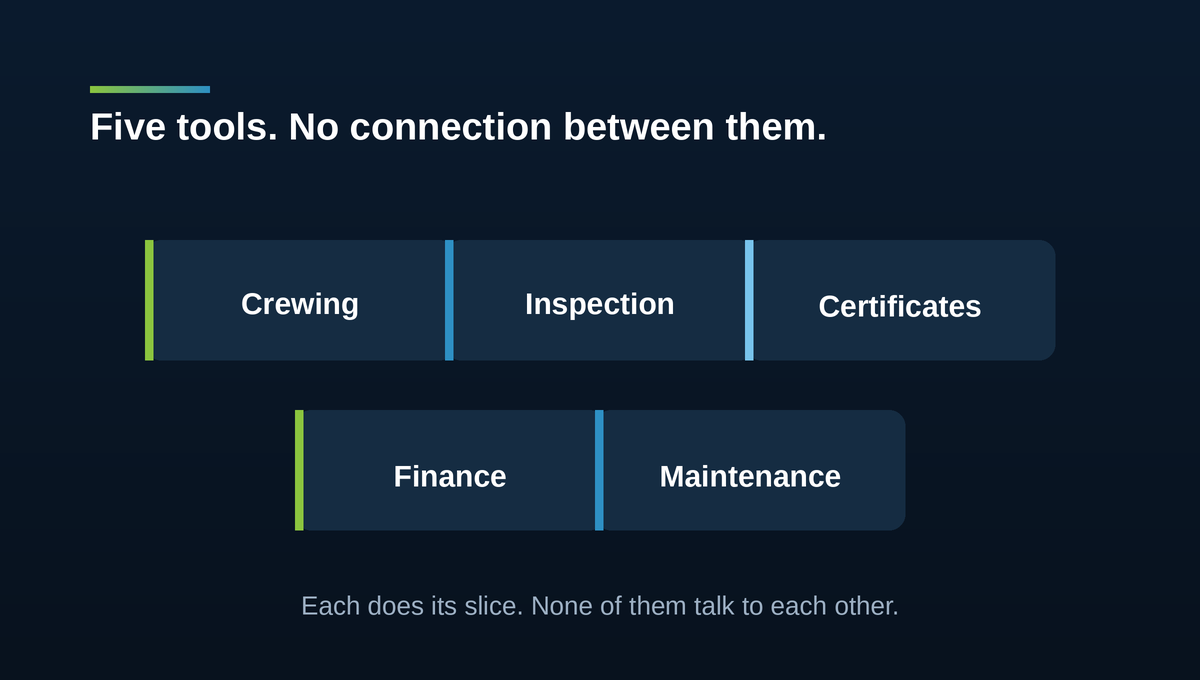
The Tax Is Not the Software. It Is the Space Between the Software.
Most conversations about software cost stop at the licence fee. That is the visible number, the one on the invoice. The integration tax is the invisible one, and over time it is usually larger.
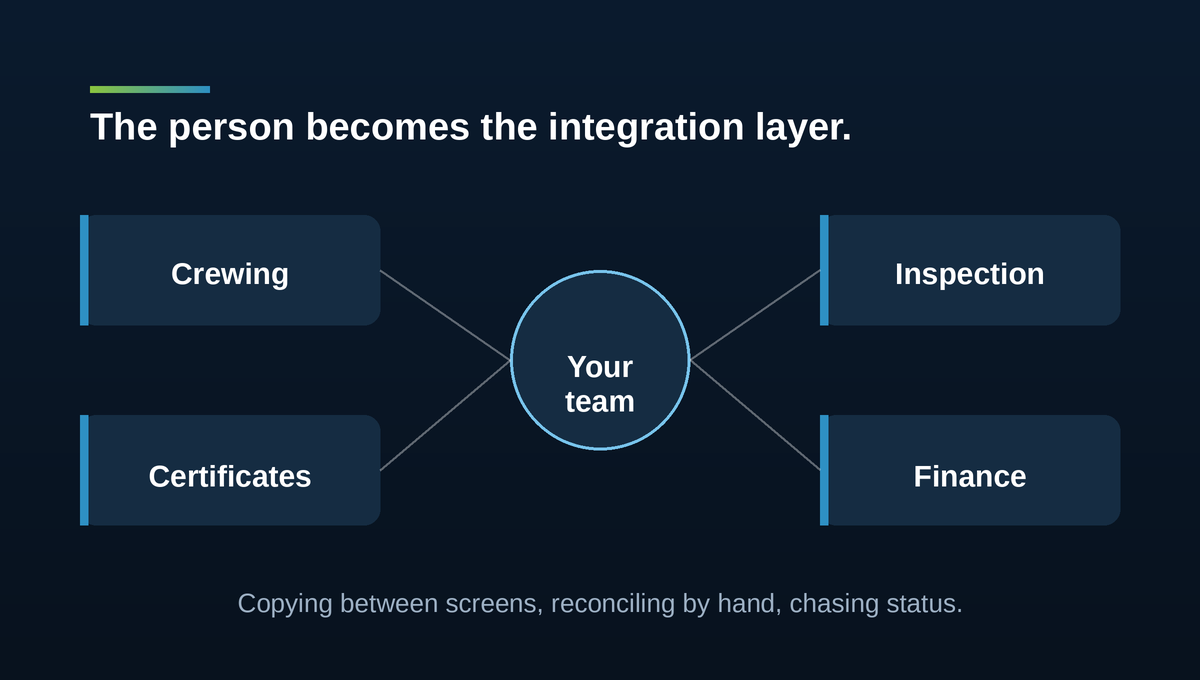
It shows up as work that exists only because the systems do not connect. Copying a crew member's details from one screen into another. Reconciling a certificate list against what the crewing tool thinks is current. Chasing a defect's status across an email thread, a spreadsheet, and a phone call because no single place holds the whole picture. None of that work produces anything. It just moves information across the gaps between tools that should have shared it in the first place.
Every seam between two systems is a place where a person has to do by hand what the software should have done automatically.
The person doing that work becomes, in effect, the integration layer. They are the human API between systems that will not speak to each other. That is a strange and expensive job to hand to a skilled superintendent, and it is happening on lean teams across the industry every day.
Why It Lands Hardest on Mid-Size Operators
A large fleet feels this too, but it can afford to solve it. It has an IT function, integration budgets, and people whose actual job is to make systems connect. The seams still exist; they are just staffed.
A mid-size operator, running somewhere between 8 and 30 vessels, has no such luxury. There is no integration team. There is a small shore staff where the same person handles crewing, certificates, and an inspection in the same week. So the seams between the tools do not get engineered away. They land directly on the people who can least afford the time, on top of everything else they are already doing.
This is the part that is easy to miss. The mid-size operator is not behind on technology. In many cases, they have as many systems as a much larger company. What they lack is the connective tissue between those systems, and the staff to substitute for it by hand. The problem was never a shortage of tools. It is that the tools do not add up to a single, trustworthy answer.
The Cost You Do Not See on Any Invoice
The time lost to manual reconciliation is the obvious cost. There are two others that matter more.
The first is decisions made on partial information. When the full picture lives across five systems, people act on the slice in front of them, because assembling the whole thing is too slow. A crew decision made without the full history. A defect closed without checking whether it had happened before. The answer was available in principle. It just was not to hand at the moment it was needed.
The second is the things that fall through the seams entirely. A certificate that lapses because it lived in one system while the vessel's status lived in another, and no one was watching the join. A follow-up that never happens because the person who needed to see it could not. These failures do not feel like software problems when they happen. They feel like human error. But they are usually the predictable result of information split across tools that do not talk.
"Just Integrate Them" Is Harder Than It Sounds
The obvious answer is to connect the systems you already have. Sometimes that is the right move. But it is worth being honest that integration is not free either.
Connecting tools means APIs, and not every system has good ones. It means paying for the integration, then maintaining it, because integrations break when either system changes. And it runs against the grain of vendor incentives: a company that sells one tool has little reason to make it play nicely with a competitor's. So "just integrate them" often becomes its own ongoing project, another thing to build and maintain, another cost that compounds.
Integration can reduce the tax. It rarely removes it, and it sometimes adds a new one.
What Good Actually Looks Like
The goal is not more software, and it is not necessarily the most capable version of each individual tool. It has the fewest seams.
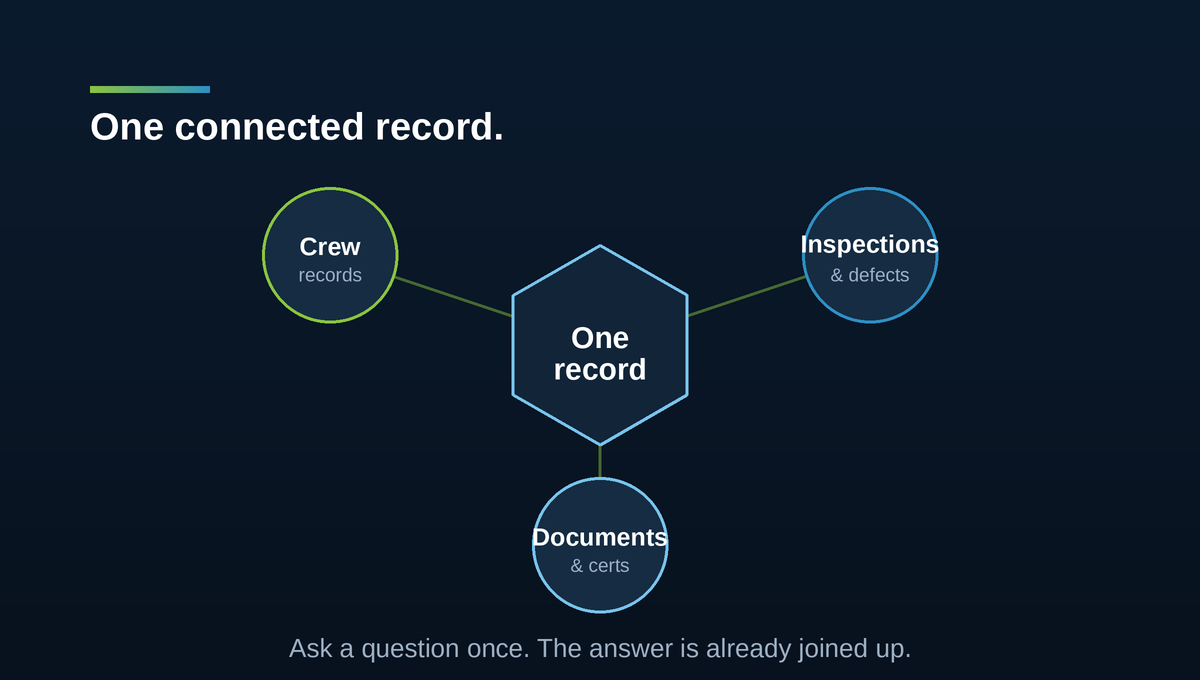
A useful test, when evaluating anything: can a person get a cross-system answer in seconds? Not "does the crewing tool work" and "does the inspection tool work" as separate questions, but "can I see this vessel's crew, its certificates, and its open defects together, without opening three things and reconciling them in my head?" If the answer is yes, the integration tax on that question is close to zero. If it is not, you will keep paying it every time someone asks.
That points toward consolidation, connected systems over disconnected best-of-breed ones, especially for a team without the staff to bridge the gaps. It is a real trade-off, and worth naming honestly: a single connected platform may not go as deep on any one function as a dedicated specialist tool. For a lean operator, the connective value usually outweighs the lost depth. For a team with the resources to integrate and maintain point tools, it might not. The right answer depends on which cost you are better placed to carry.
Where SailMind Fits
For transparency, here is our own answer, kept short.
SailMind was built to remove the integration tax for mid-size operators specifically. It keeps crewing and inspections on one connected record, so the crew history, the documents, and the defect status are joined up rather than scattered across separate tools. The intent is that a cross-system question, the kind that used to take an afternoon, has one place to be answered.
That is where we fit. Whether or not it is us, the underlying point holds for any mid-size operator: the question that matters is not how many tools you have, or how good each one is on its own. It is how much you are paying, every day, for the space between them, and whether that tax is one you can keep affording.